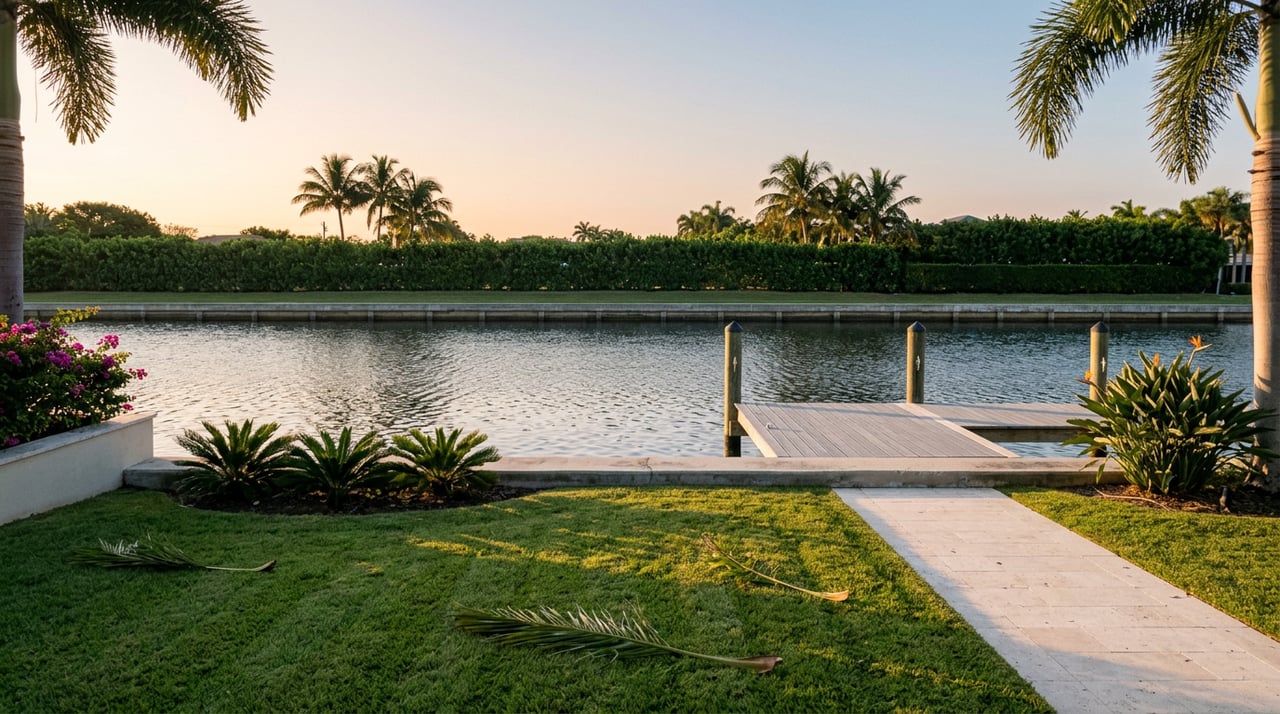
Two canal-front homes go under contract the same week in Aqualane Shores. Same flood zone. Same general age. Same asking price range. One closes on schedule. The other sits in escrow for six extra weeks while the buyer's lender waits on an insurance quote that keeps getting revised upward. The house didn't change. The zone on the listing sheet didn't change. What changed the outcome was a piece of paper one seller had ready and the other didn't: a current Elevation Certificate, paired with a seawall inspection report less than a year old.
That gap is about to matter more, not less. Collier County is in the final stretch of updating its Flood Insurance Rate Map, and for anyone buying or selling on the water in Naples this year, the real risk isn't that your zone label might shift. It's that you'll find out how thin your paperwork is at the worst possible moment in a transaction.
The Map Is Moving, But That's Not the Story
The flood map Collier County currently uses to set insurance and construction requirements took effect on February 8, 2024. County officials said in August 2026 that the updated version, known as the Physical Map Revision, is nearly complete, and earlier projections placed formal adoption sometime between August and October of this year. According to WINK News, once the county adopts it, property owners typically get a 90-day window to appeal specific determinations before the new map becomes final.
That timeline puts the revision on a near-collision course with anyone closing on Naples waterfront property between now and early 2027. If your listing goes live this fall, there's a real chance the zone designation on the property could shift somewhere between the day you sign a contract and the day you close.
Here's the part that surprises people: a zone change alone rarely determines what you'll pay for insurance or what your home is worth. What actually drives your premium is the relationship between your home's lowest floor and the base flood elevation for that specific parcel, which is a number a zone letter alone doesn't tell you.
Why the Zone Label Was Never the Whole Story
Naples Reserve is the clearest recent example. In February 2024, a FEMA panel revision moved a group of Naples Reserve properties from the lower-risk Zone X into Zone AE, the same event that produced the current effective map. Two houses on the same street ended up in different flood categories, because of the pad they were built on rather than the label attached to the block.
The City of Naples takes elevation seriously enough that its own building standards generally call for finish floor elevations within city limits, well above the base flood elevation in many zones. A home built to that standard can carry dramatically different insurance economics than one next door that predates the requirement, even if both currently sit in Zone AE. Flood insurance on Naples waterfront property is often quoted somewhere in the range of $1,500 to $6,000 or more a year as of mid-2026, and where a given property lands in that range has far more to do with its documented elevation than with the zone letter on its listing sheet.
This is why the smartest move for a seller isn't waiting to see where the new map lands. It's ordering a current Elevation Certificate now, before a buyer's lender asks for one under deadline pressure.
The urgency is sharper because the segment of the market where this plays out most often isn't slowing down the way the rest of Naples is. As of early August 2026, the broader Fort Myers and Naples region had settled into a fairly balanced 5.0 months of single-family inventory, a market where buyers finally have room to negotiate. The ultra-luxury waterfront tier tells a different story. In the most recent neighborhood-level report, covering January 2026, average closed prices ran $6.38 million in Old Naples, $9.51 million in Aqualane Shores, and $23.51 million in Port Royal. Months of supply fell sharply across all three over the prior year, from 29.54 to 13.80 in Old Naples, 28.50 to 15.72 in Aqualane Shores, and 25.26 to 11.60 in Port Royal. Inventory is genuinely tight in the very neighborhoods where flood documentation questions matter most.
| Neighborhood | Jan 2026 avg. closed price, single-family | Months of supply (Jan 2025 → Jan 2026) |
|---|---|---|
| Old Naples | $6.38 million | 29.54 → 13.80 |
| Aqualane Shores | $9.51 million | 28.50 → 15.72 |
| Port Royal | $23.51 million | 25.26 → 11.60 |
When supply is that thin, a buyer with financing lined up and paperwork ready wins the property. A seller who can hand over a clean Elevation Certificate and inspection file on day one keeps that buyer instead of losing them during a stalled due diligence window.
What a Seawall Inspection Actually Finds
Most sellers assume a seawall is fine if it looks fine from the dock. That assumption is exactly what causes the problem. A wall can hold a straight, painted cap while leaning a few degrees below the waterline, and soil loss behind the panel works quietly for years before the cap finally drops. In Old Naples and Port Royal in particular, seawalls have a reputation among local marine contractors for hiding real damage behind a clean, freshly painted surface.
A proper Naples seawall and dock inspection covers five things: the cap, checked for cracks, spalling, and rust staining; the panels themselves, checked for cracks, gaps, or movement; the tie-back rods and dead-man anchors that hold the wall against soil pressure from behind; the weep holes, checked for blockage or the early signs of undermining; and the shoreline soil, checked for sinking or voids that signal trouble long before it's visible from above. Local marine builders also note that a dock piling that lasts twenty years in freshwater can fail in as little as eight years in a Naples canal, where warm, brackish water and constant tidal flow accelerate wear that owners in freshwater markets never have to think about.
The flood zone on a listing sheet answers one question. The Elevation Certificate and the seawall report answer the one buyers and lenders actually ask.
The Real Cost of Waiting
Recent local estimates put a typical Naples seawall repair project somewhere between $5,000 and $25,000, with full replacement running well above that depending on length, material, and access. Those numbers matter less as a line item and more as a negotiation trigger. A buyer's inspector who finds an undocumented crack or a soft spot behind the cap during a due diligence period doesn't just ask for a repair credit. They ask for time, and time is what kills deals in a market this tight.
Sellers who order their own inspection before listing get to control that story. They can price around a known issue, complete an inexpensive repair before it becomes a negotiating point, or simply document that the wall is sound and take that uncertainty off the table entirely. Buyers who request an Elevation Certificate and insurance quote before removing contingencies avoid the scenario where a policy comes back three times higher than expected after they've already fallen in love with the house.
A Pre-Offer Checklist for Naples Waterfront
- Pull the property's current flood zone using the FEMA Flood Map Service Center, then check it again against Collier County's own preliminary comparison tool once the updated map is published.
- Request or order a current Elevation Certificate. If one exists but predates recent renovations or a fill grade change, order an update rather than relying on the old document.
- Schedule a seawall and dock inspection that covers the cap, panels, tie-back anchors, weep holes, and below-waterline condition, not just a visual walk from the yard.
- Get an actual flood and homeowners insurance quote during your inspection period, not after you've removed contingencies.
- If the property sits in a community built partly on fill, such as parts of Naples Reserve, ask whether a LOMR-F was ever filed and where the paperwork lives.
- Keep every document, the survey, the elevation certificate, the seawall report, and any permit history, in one file that travels with the property through closing.
None of this replaces advice from a licensed surveyor, insurance agent, or real estate attorney on your specific parcel. What it does is put you in the position of the seller whose deal closed on time instead of the one still waiting on an insurance quote six weeks later.
The Naples waterfront market isn't slowing down enough to make this optional. Inventory in Port Royal, Aqualane Shores, and Old Naples is tighter than it's been in over a year, and a flood map revision is working its way toward a final vote this fall. The buyers and sellers who treat their paperwork as part of the property, not an afterthought, are the ones who keep their closing dates.
If you're weighing a purchase or preparing to list on Naples water, Jill Nicholas can walk your specific address through this exact process, from pulling the current flood determination to connecting you with the right marine contractor and insurance contacts before you're under a deadline. Request a consultation and get ahead of the paperwork instead of chasing it.
Frequently Asked Questions
Will the new flood map affect a home I'm already under contract on? It depends on when the county formally adopts the revision and when your closing is scheduled. Ask your lender and insurer to check both the current effective map and the preliminary version for your specific parcel rather than assuming nothing will change before closing.
What is a LOMR-F? It's a Letter of Map Revision Based on Fill, a FEMA determination.
How often should a Naples seawall actually be inspected? Most residential seawalls in Florida benefit from an inspection every one to two years, moving to annual for walls facing heavy boat traffic, high tidal exposure, or a history of prior repairs.
Does a higher flood zone always mean a lower home value in Naples? Not necessarily. Some of the city's most sought-after addresses, including parts of Port Royal, Aqualane Shores, and Old Naples, sit inside mapped flood zones because of their proximity to Naples Bay and the Gulf. Elevation, construction standards, and documentation tend to influence value and insurability more than the zone letter alone.
This article is general information, not legal, tax or financial advice. Consult a qualified professional about your situation.